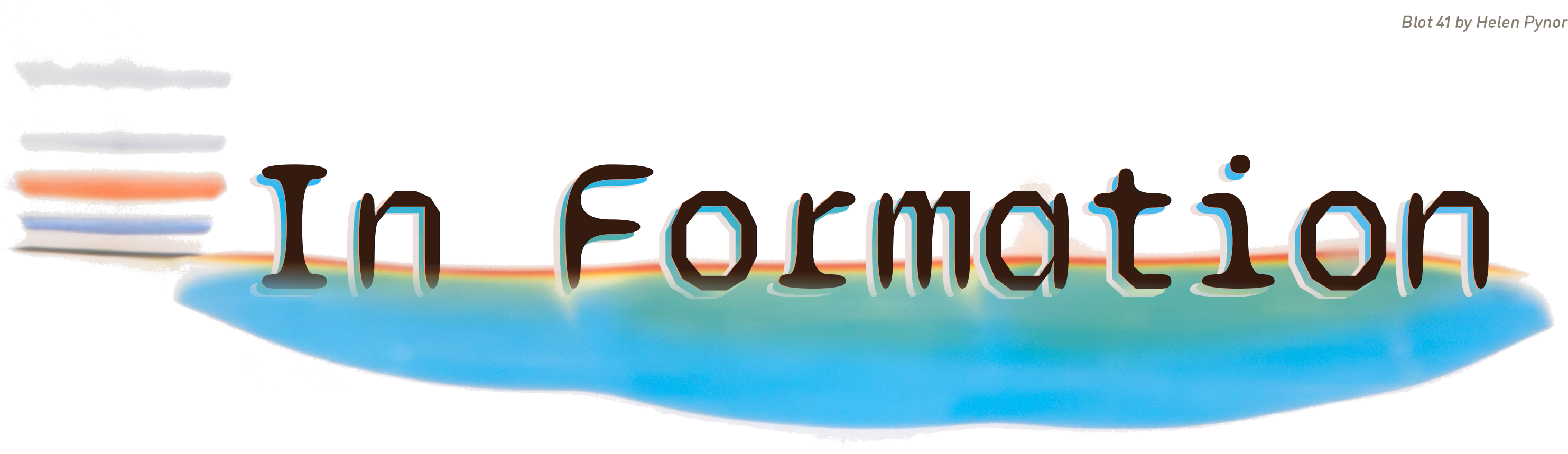
In Formation presents four artist-in-residence projects that delve into the science of constantly forming cells that constitute the complex processes of life, specifically cell fates, cell memories and DNA replication. The artists Anna Dumitriu, Solveig Lill, Pei-Ying Lin and Helen Pynor explore through a rich diversity of artistic media and practices in collaboration with scientists laboratory and experiment practices as well as the imagination and representation of cells.
Claudia Schnugg
Lead scientist
Maria-Elena Torres-Padilla
Participating Artists
Anna Dumitriu, Helen Pynor, Pei-Ying Lin, Solveig Lill
Scientific Partners
Helmholtz Munich, Institute of Epigenetics and Stem, RepliFate European doctoral network on DNA replication
Exhibition Dates
5 to 8 July 2026
Opening Hours
5 to 10 pm
Opening Reception
Sunday, 5 July, 5pm
Panel Discussion
On DNA and Art, Wedensday 8 July, 7pm
Venue
Muffatwerk Munich
Venue Address
Zellstraße 4, 81667 München-Au-Haidhausen
Exhibition On-Site Production Team
Florian Förg, Tobias Mörtl, Felix Ehrig, Andreas Franzler, “Francis” Johann Fraunrieder, Florian Haderer, Dietmar Lupfer
The exhibition unfolds throughout Studio 1 and Studio 2 at Muffatwerk Munich, Pei-Ying Lin and Solveig Lill in Studio 1, Anna Dumitriu and Helen Pynor in Studio 2
Supported By

Artworks
Anna Dumitriu
The Mutability of Memories and Fates (2024)
Video projection with soundDo induced pluripotent stem cells retain memories of the cells they once were?
This artwork follows a single population of stem cells as they are repeatedly transformed into brain, lung, heart, and liver cells, then returned to a pluripotent state. Blending footage from a laboratory experiment inspired by the artist’s question, the video shows a single population of cells continuously forming and shifting between induced pluripotent stem cells and differentiated states. Weaving regenerative medicine with alchemical ideas of transformation and immortality, it asks whether identity and memory—can ever be fully erased.
Credit: Anna Dumitriu, in collaboration with scientists Professor Maria-Elena Torres Padilla, Dr Federico Pecori, and Marion Genet (Institute of Epigenetics and Stem Cells, Helmholtz Zentrum Munich), and creative technologist Alex May.
The Cellular Reprogramming necklace (2021)
Sculptural installationThis sculpture in the form of a tangled necklace physically explores the chromatin structure of the OCT-4 gene.
Credit: Anna Dumitriu, in collaboration with scientists Professor Maria-Elena Torres Padilla and Dr Adam Burton (Institute of Epigenetics and Stem Cells, Helmholtz Zentrum Munich) and creative technologist Alex May.Materials: 3D printing, jewellery wire, ribbon, copper sulphate, DNA
Totipotence (2023)
Sculptural installationDumitriu was interested in whether a bird’s egg would be considered a totipotent cell, and this artwork explores that philosophical question.
Credit: Anna Dumitriu, in collaboration with scientists Professor Maria-Elena Torres.Materials: Handmade bird’s nest form with copper sulphate covered blow goose egg
Identity in Flux (2023)
Video installationThe artist performed the fiddly process of extracting the nucleus from the surrounding egg using a nucleus which had been dyed blue to make it more visible. The video work explores this process under the microscope.
Credit: Anna Dumitriu, in collaboration with scientist Dr Eva Hörmanseder (Institute of Epigenetics and Stem Cells, Helmholtz Zentrum Munich).Materials: Video installation
Helen Pynor
Artist statement
The molecular processes taking place during DNA replication unfold at flickering speed, with a dynamism and complexity beyond human perception and almost beyond human imagination.
The movement of hundreds of complex molecular species is an intricate, beautiful choreography, played out slightly differently each time a stand of DNA replicates, in which dancers in perpetual motion touch, interlock and glide around each other, to a score that is both scripted and improvisatory, the entity as a whole being primed to compensate seamlessly at any moment for more extreme deviations from the score.
I’m interested in the uncertainty borne of this unfathomable complexity, its stochasticity, in tension with the seemingly contradictory quest for scientific certainty. In some works I have used ‘blur’ as a visual language to refer to the uncertainties that hover at the edges of scientific findings. Other works express the sense of mystery and wonder I see in life’s inventions, or how questions of scale confound our human perception, for example the existence of 2 metres of DNA (if unravelled and joined end-to-end) in each cell of the human body.
In all works I have endeavoured to use extracts generated through my collaborating PhD Fellows’ research as source material for my works, not to present as scientific data but to express this beautiful uncertainty, and the wonder and respect I feel for the exquisite entities the Fellows are studying in such intricate levels of detail.
The artworks represent different collaborations with Helmholtz Munich: Yicong Chen and Maria-Elena Torres-Padilla, Patras Medical School: Alexander Haider and Zoi Lygerou, CSIC/UAM Ran Tong bei Maria Gomez, Juan Mendez and Ioana, CBMSO at Spanish National Research Council Scott Churcher and Emilio LeconaBlot series (2026)
Blot 10Blot 16
Blot 21
Blot 28
Blot 41
Blot 88
Installation with 6 pigment prints, mounted on Aludibond
Cloud (2026)
Single channel video on screen (07.27 min)Early Middle Late (2026)
Pigment print on tracing paper2 Metres (2026)
Pigment print, mounted on AludibondSpread (2026)
Pigment print, mounted on AludibondExtra series (2026)
Extra 1Extra 2
Extra 3
Extra 4
4 dye Sublimation prints on synthetic silk
Metaphase (2026)
Single channel video on screen (00.16 min)Scatter (2026)
Single channel video on screen (05.00 min)Pei-Ying Lin
A Textile Study of the Craftsmanship in Biolabs (2026)
Installation with four textiles and 4-channel soundBiological Wet Lab requires highly skilled craftsmanship. In order to discover the underlying mechanisms of living organisms, many of which are invisible to the human eye, scientists still have to use their human bodies and hands to interact with the complexity and use different techniques to contrast and reveal what is hidden. The hands-on skills of handling samples, planning strategies that would allow us to understand the materiality and vitality, and awareness of the procedural steps, speak much to the similarities with textile making. In this project, each textile installation speaks the craft wisdom from the biological wet lab where the artist had a residency, accompanied by the recordings collected for the conversation between the artist and the scientists about how they deal with the physicalities correlated with the wet lab practices. It is an investigation through making for the shared attention and attitude towards the physical otherness between the biological lab and the crafts.
Collaboration partners: University of Copenhagen - Marta Olivia Santiago and Julien Duxin with support of Ellen Sofia Kakulidis, Mads Meier, Xueyuan Leng; Netherlands Cancer Institute - Kaustav Majumder and Titia Sixma, Lead Discovery Center - Utkarsha Pande and Bert Klebl, Kathrin Klebl, Leiden University Medical Center - Hồ Mỹ Phúc Võ and Sylvie NoordermeerProduction collaborators: Eindhoven University of Technology Wearable Senses Lab, Femke Vorselen, Milou Voorwinden, Kristina Andersen, EE Labels, Karolina Tomaszewska
Solveig Lill
Cell lines (2026)
Coloured pencil on paperThe series of drawings has grown throughout the two and a half years I’ve spent participating in the Replifate program. The images are derived from observations of different cell cultures and associated microscopic imaging during my visits to laboratories, as well as from numerous conversations with fellows across the Replifate network. Some of the works contain direct references to specific visual or verbal sources, but for the most part they form a synthesis of the many influences and materials I encountered during this highly enriching period. In the process of creating, I have allowed myself to let go of strict adherence to factual accuracy in interpreting what I have seen and heard, leaving space for something new to emerge through the act of translation itself.
A close-up view of the everyday work of scientists has made me keenly aware of the many similarities our professions share. Both are engaged in a continuous search for connections yet to be made, reaching towards territories still to be discovered.
Collaboration with CSIC CABIMER Elena Pietrini and Andres J. Lopez, CNRS and University of Montpellier Silpa Mary Johnson and Philippe Pasero, University of Zurich Virginia Pasti and Matthias Altmeyer, University of Zurich Institute of Molecular Cancer Research Julius Thomas and Lorenza Penengo